Barry Mishkind

The Broadcasters' Desktop Resource

Nautel-1

In the Trenches

Radio In The Good Old Days

Radio today is very much different than several decades ago. And not just because studios have become little more than a microphone and a computer. As Ron Schacht recalls, in the Good Old Days, life was never dull. Older engineers will remember this well. Younger folks may find this taste of the way […]

Continue reading

Don’t F— It Up!

This story is a good example of the way we broadcasters often have to troubleshoot and fix problems, both in work and in life. The deal is: fix all the stages of a problem, one by one, until it all works! I am sure every radio engineer has had to […]

Continue reading

Sites You Visit Only if You Really Want To!

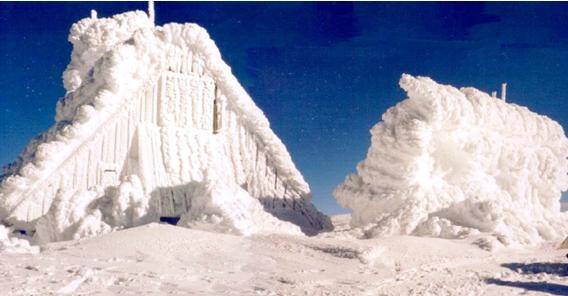
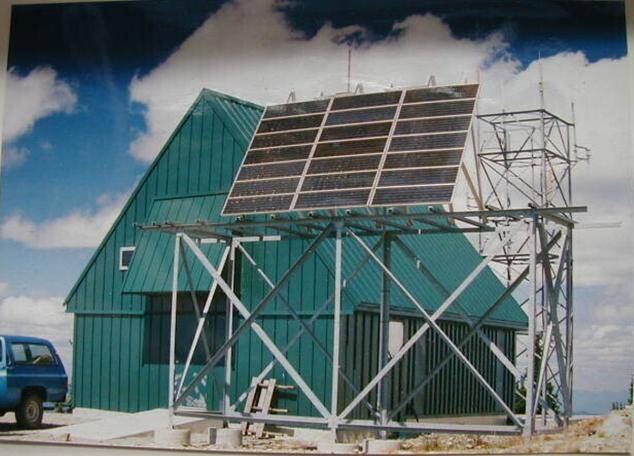
July 2021 – Sometimes a picture needs context to really illuminate what we are looking at. Here is a pair of pictures from the same site, but the key point here is the “when.”

There is no end to the wide variety of sites that broadcasters use. They range from the remote rural areas to remote mountain tops – and everywhere in between.

Access can be as varied as well. Some sites are easy to drive up to in any vehicle. Others require four-wheel drive vehicles. And still others require walking in anywhere from a few hundred yards to a mile or more – especially when a snow cat is not available.

Fortunately, most of the worst sites in terms of access are not always that way all year long.

Which brings us to this particular example.

There is Something in There

This first picture was shared last year, and the initial response was “wow! That is a transmitter site?”

At first glance this kind of almost looks more like some ice cream or cotton candy novelty display.

Some contact with the person who shared it brought assurance it was a true transmitter site (although it might be one you have to “dig into” a little bit).

And, both the challenge of the site and the remoteness are verified by fast forwarding a few months to see the summertime picture of the site.

Another Season

You may have to rotate your mental view, but it is pretty easy to see that this is the same site.

And, without the snow, it is also clear that there is no incoming electrical feed. Everything is fed by the power generated by the solar panels.

One thing is very clear: anyone who goes up to this site needs to ensure they have everything they might need, especially in bad weather.

– – –

Do you have a site that is especially challenging to get to or just plain interesting to see? Please do share a picture or two (or three!).

– – –

Our thanks to Karl Shoemaker and the Spokane Repeater Group for sharing these pictures with us.

– – –

Continue reading

The Day a Cow Took Our Radio Station Off The Air

Throughout my years as a Broadcast Engineer I have seen a lot of things disrupt the transmission of a broadcast station whether it be TV or Radio.

I have seen just about all types of critters shut down a transmitter: moths, flies, snakes, an occasional mouse – but nothing like this!

I was sound asleep when my phone started its frantic beeping indicating we had a problem somewhere. It was 1:30 AM, I looked and found that we had lost our audio feed out in central Nebraska. Being that we program the majority of our stations on the network using the Internet as a way to transport the programing out to the various transmitter sites I figured it would be back shortly after a brief outage. There were late night storms prowling out on the plains this morning and brief power outages were not uncommon. I went back to sleep.

My alarm clock went off at 6:30 and I was up to start the day. I arrived at the studio by 7:30 and found right away as I walked into my office that our signal – KJWM – was silent. You see I have this computer monitor that shows all the stations audio levels, and if one or more are dark then I know there is an issue.

After a few phone calls to one of the Engineers with the local television station who owned the tower we are on, I asked if the power was out due to storms overnight. I was told that they indeed had power. Okay then, what was up with our equipment? So, I loaded up a few things not knowing what I would find and made the two-and-a-half-hour drive to our site south of Wood River.

The drive was uneventful for the most part, I chatted with a few friends on the ham radio and made a few phone calls to other broadcast folk. I arrived at the site. It is literally out in the middle of a pasture. Knowing there is usually livestock grazing, I make it a point to close the gate behind me as I was not in the mood to play cowboy. So, I pulled up to the building and went inside. Lights come on, check; air conditioning is on check; the transmitter and a rack full of gear not on.

As a general rule when going out to a site I think about what I may encounter and what tools I need to have at the ready. I had my Volt meter and a screw driver in my back-pack so first thing was to check breakers, they were all on so then it was remove the cover from the breaker panel. Checked for Voltage coming in from outside; no Voltage! Well then, maybe we had a blown fuse out at the meter.

Out in the middle of the pasture (oh, did I say our site is in the middle of a pasture?) there is a pole that has our power meter and a disconnect box. When we put the station on the air several years back I made it a point to fence around the pole so any livestock would not rub on the box, thereby removing it from the pole. After a short walk I got to the pole and noticed the switch that was on the side of the box was in the down position – which is off!

I probably looked like Stan Laurel from the old Laurel and Hardy days standing there scratching my head wondering “who in the world would walk out to this pole at 1:30 in the morning, in the pitch dark – and possibly stormy weather – to shut off a radio station’s power?” After checking the fuses in the box (they were fine) I flipped the switch back on and walked back up to the building.

Upon entering I could hear the sounds of morning programming on Spirit and observed everything was back on. I went ahead with my usual routine and did a quick maintenance and calibration then proceeded to head out.

The only thing I can surmise from this is that a member of the local bovine community must have managed to reach her nose in over the wire fence to scratch an itch and thus shutting down KJWM-FM. This is a first for me…. I grew up around cattle and horses and I’m fully aware of what these creatures are capable of but to shut off a radio station?

Oh, there was a fix for this! As I do not like to put locks on electrical panels or switches for safety, a simple pin worked just fine. If the fire department would ever need to de-energize the site, all they had to do is pull a pin.

And should Miss Bossy want to scratch that itch again, she will not be able to shut the power off.

Contributed by Mark H Voris
Chief Engineer for the Spirit Catholic Radio Network


Exhibit 1:

In my early career as the “electronic janitor,” for a station in Pennsylvania, I noted that the meter readings could no longer be calibrated on the home-brew remote control panel. I could calibrate the plate current and the plate voltage. However, the antenna current, that normally read near full-scale could no longer be calibrated. I started to investigate.

It turns out that the “remote control” unit consisted of a DPDT toggle switch, three meters, three potentiometers, and a nine-volt “transistor radio” battery. The battery was getting low.

Transmitter ON/OFF was provided by connecting the physical-pair phone line in series with the 120-volt coil of the plate relay.

Contributed by Richard B. Johnson


Continue reading
Jampro

When the County Says “Move That Tower!”

Often, broadcasters operate as a business, getting the job done. But often, having a good relationship with local governmental authorities will help when dealing with important matters that impact the station operation. Ted Thayer recalls: A recent item in the Broadcasters’ Desktop Resource brought back memories of an incident I had to endure […]

Continue reading

Doing the EBS Dance

Before the Emergency Alert System (EAS) there was EBS – The Emergency Broadcast System. Several things led to its abandonment and the implementation of EAS. Dave’s story involves a technical issue that caused many problems.

EBS tests used to be a real joy buzzer. After the announcement of the test, the station was supposed to drop carrier for five seconds, come back up with a dead carrier for five seconds and then go off again for five seconds before running a 1 kHz tone.

The problem was, in the day, there were many transmitters that were not as stable or reliable as they are today, and often the five seconds would end up as minutes or longer, as transmitter repairs commenced.

Some Reliability on AM

I had modified our two AM daytime Continental transmitters, the 317B, 50 kW and the 316B, 10 kW day auxiliary for EBS tests by installing a red front panel button labeled “EBS.”

Basically, it was a normally closed AH&H pushbutton with a red cap. All it did was open the interlock to the excitation relay in each of the transmitters. You pushed the button for five seconds to go off the air, released it five seconds to come back up, and pushed it again for five more seconds off.

As we put it into service, it made it easier for the operator and bypassed some type of step-start in the plate supply since you left plate voltage on.

Meanwhile Over on FM

On the other hand, our sister station KNUS-FM. had a wonderful ITA FM-7500B transmitter

The Chief Engineer said he sure wished we the FM tests could be as simple as on AM. The ITA had a screen delay circuit, but was a noisy transmitter. Since the CE figured its PA was stable, I started looking for ways of killing drive.

My first experiment was just trying to bring the transmitter up without drive. No, No, NO! “Bam!” That definitely did not work.

I then played with the muting drive in the exciter driver. Once again lot of noise and – “bam” – this time we lost enough parts to be off of the air for over eight hours. Worse, there was no auxiliary transmitter. Oops!

We tried other options, but after our suffering one or two breakdowns a month – always during or immediately after the EBS test – I finally gave up on installing an EBS button. I had it with EBS on FM.

Then, one day we found a sort of non-standard solution – and it worked!

A Solution, Sort Of

By law I had to run the tests.

But, really, no one was monitoring us since the FM’s were just audio relays in those days. The AM’s were the primary and secondary alert stations.

My big idea was to take the EBS Test Cart into the production room and made a new one using an FM tuner that was tuned between stations. On the air, the audience heard “This is a test of the Emergency Broadcast System. This is only a test.” This was followed by white noise for five seconds, dead quiet for five seconds, more white noise for five more seconds, and then, finally, the 1000 Hz tone and end announcement: “This concludes this test of the EBS system.”

With that little adjustment, we did not have any more transmitter failures due to EBS.

However, there was this one other local engineer who caught me on it. My “white noise was too loud,” he said.

– – –

Sadly, “The Mouth from the South” was silenced when Dave Hultsman passed away on August 27th, 2015. The broadcast industry lost one of its best. We all will miss Dave.

Fortunately, in his six decades as a broadcaster, he told a lot of stories – many of which he told on himself – about the building of the radio industry. There is no way to share them all, but if you have a Dave story, please share it here!

Continue reading

My First View From The Very Top

In the days before liability and insurance issues, many engineers also changed out their own light bulbs – yes, including the ones at the top of the towers. How would you react the first time you were told to do it? Ted Thayer reaches back exactly 50 years to recall his first time […]

Continue reading

KRKO and Sister Station do Digital AM

After Over the weekend of October 2-7, KRKO, and sister station KKXA were picked by NAB Labs to conduct experimental broadcasts of digital only radio on AM.

In part, the Press Release said:

Everett, Washington ? If you?re hearing silence on your radio this weekend, it may be time to purchase a new receiver. The Federal Communications Commission has approved experimental test authority for Everett area radio stations KRKO-AM and KKXA-AM to serve as the final all-digital test stations out of nine chosen by NAB Labs, a division of the National Association of Broadcasters. The testing will require both radio stations to broadcast their programming utilizing all-digital HD Radio? Technology and temporarily suspend their analog broadcasts for periods of time between October 2 and October 6, 2014. NAB Labs is collecting test data to better understand the performance characteristics of all digital transmissions via AM radio. Results of the tests will be processed and submitted to the Federal Communications Commission in 2015.

May 17, 2011

KRKO Steel Firmly Planted

After a decade-long fight with zoning commissions and vandalism to its site just as it had finished building the first of two diplexed stations, Andy Skotdal’s KRKO site is getting ready to finish the second station.

The final two additional towers were stacked on this date and, as construction is finished, the plan is for KKXA (1520) to join KRKO (1380) on the air over the summer.
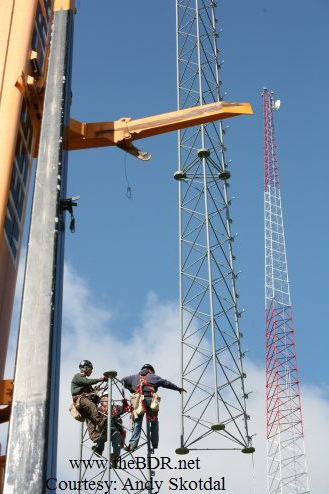
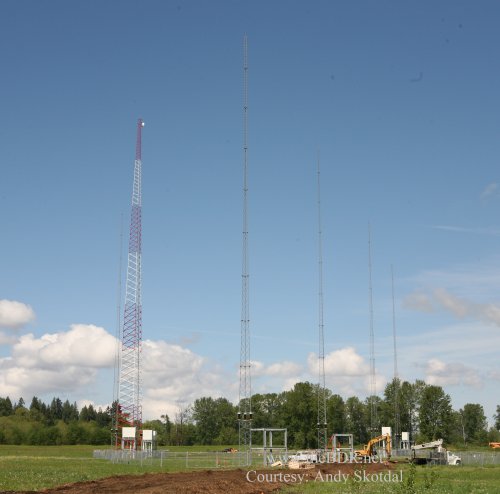
Six towers now stand in Everett, WA

KKXA (a nod to the original KXA (770)) will start at 20 kW Day, 50 kW Night on 1520, then jump to 50 kW fulltime. KRKO has a similar plan, to move from 34 kW Day, 50 kW Night, to 50 kW fulltime.

Read below for more of the story on the long struggle to build this facility. Additionally, for those interested, summaries of the zoning hearings were posted on the Internet. Some of the material is here, and here, and here. There are video clips from the hearings posted – complete with such typical accusations as the towers will kill property values and RF will kill children. There was even one man claiming that the farther the distance from the antenna, the more dangerous the RF. (Note: The video appears to require certain browsers or versions to work properly on PCs, or a plugin for Apple. For example, IE works, Firefox 4.0.1 did not – at least when this is written.)

This is almost the poster picture of how hard it can be to build towers these days.

September 2009

KRKO, Everett, WA, loses two towers to vandals.

Early on September 4, 2009, neighbors reported three people running from the KRKO site. Inspection later on in the morning showed their tallest tower and one of the other three were knocked over by a trackhoe.
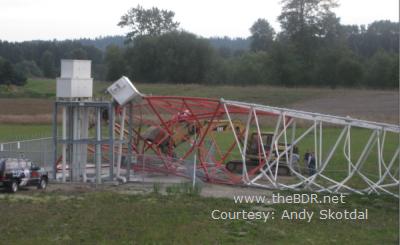
Fortunately, no one was hurt. According to station owner Andy Skotdal, the station never went off the air, although it is now operating from its back-up site.

Although KRKO has not accused anyone of the vandalism, late Friday (Sept 4th), one of several websites for ELF (the eco-terrorist group Earth Liberation Front) claimed responsibility. The spokesman made typical statements blaming AM radio for health problems and trying to justify their vandalism.

KRKO is offering a $25,000 reward leading to the arrest and conviction of the vandals.

One group of eco-terrorists have claimed responsibility.

The station has already started to rebuild the towers.
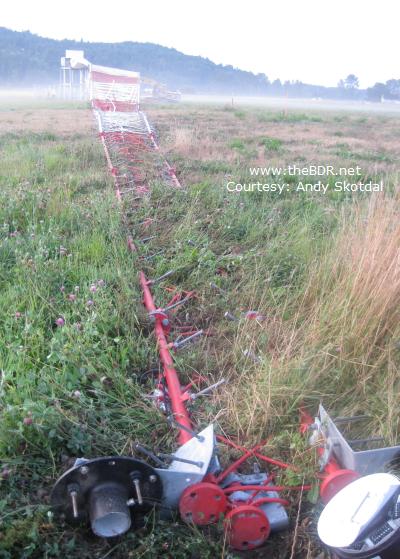
KRKO Radio in Everett, WA has been fighting a battle for something like 10 years to construct the tower site.

The usual petition drives and arguments were dusted off, photocopied, and presented by all the neighbors. Stories about irradiating children – and worse – caused fear and loathing. Fortunately, Skotdal and his company were able to prevail at the hearings over the emotional and pseudo-science presented against the station.

Now that the site is up and running, it appears the attacks have become physical.

Also there are video files of the hearings on the Snohomish County Zoning Board web pages. They make for interesting listening, as the various allegations of RF dangers are tossed out. The entire situation presents a lot of valuable information to other stations in dealing with zoning boards and local protests.

There used to be more video of the site and vandalism, but the station appears to have scrubbed it off the website.

Continue reading