

Danger From Consumer Parts

[May 2026] Over the years, either due to budgetary issues or the fact that some new products can solve a problem in the studio or transmitter sites, many stations have purchased consumer electronics to do jobs from CD players to security camera. There are some aspects that need consideration before implementation. Ron Schacht elaborates;
Anyone who has been around for a while is well aware of the lack of quality of many products manufactured today, compared to a couple of year ago.
Some examples: 2×4’s are no longer that, the steel used in automobiles is closer to aluminum foil than real metal, electrical wire in automobiles is much smaller gauge that it had been. Everything is made to bare minimums and at a much higher price. This applies to items made in the US and much more so to foreign made items.
Electrical products such as receptacles, switches, junction boxes, panel boxes and so on are no exception. Just pick up a 60 Amp disconnect from 50 years ago and one made today and the weight will tell you everything. Overall, items for home use often have a lower quality than items intended for commercial use, so be very careful when specifying things like electrical installations – especially at a transmitter site.
I had a frightening experience recently with an electrical issue and wanted to share it with others to avoid someone else not being as lucky.
A TRANSMITTER UPGRADE
A few months ago, I was asked to install a transmitter at an FM site in a very rural location.
The station had been using a Harris FM5 since their start. There was no three-phase power for miles so they used a Kay Phasemaster to produce the third phase.
Over time, someone was able to locate a Harris HT5 for them to bring the station closer to the twenty first century. The transmitter was delivered with some missing components like the IPA, so we gathered up the missing components from other places.
ASSESSING THE ELECTRICAL SYSTEM
The building has a 200 Amp fused disconnect right off the pole.
Out of the disconnect are several taps. There is a 100 Amp breaker panel for lights, racks, tower lights, etc. Then there is also a 100 Amp panel for the HVAC system with just one 50 Amp circuit breaker. There is a 60 Amp disconnect for the FM5 and a 60 Amp circuit breaker for the Phasemaster bringing it up to four separate circuits out of the 200 Amp main.
Not wanting to use any of those breakers, and wanting to keep the FM5 workable as an auxiliary, we decided on another 60 Amp circuit off of the 200 Amp main would be best as the HT5 single phase consumes about 38 Amps.
I asked that a fused disconnect be installed.
THE NEW BREAKER PANEL
When I got to the site, a separate breaker panel was put in with a double-pole 60 Amp breaker.
The electrical supply house had no fusible disconnects so the installer went to the big box home improvement store and bought this 100 Amp box with one 60 Amp double-pole breaker.
The panel was wired nicely with #4 copper wire but I have always been reluctant to run a transmitter on circuit breakers meant for home use. Against my better judgement, I ran conduit, pulled three #4 copper wires through, and wired up the transmitter.
WE ARE ON THE AIR!
It took a few more days of plumbing in the RF patch panel, remote control, and the rest of the installation to get everything connected.
We then fired up the HT5, and after several hours of tuning got it making 5 kW with no problems so we put it on the air – and shut down the old FM5 and the phase converter.
Over the next several hours, we watched the system closely, checking for hot spots, hot wires, and tuning changes. The newer transmitter was running just fine, so we made our 4-hour trip back home.
WE ARE NOT ON THE AIR!!
Five days later we were called and informed that the HT5 was off the air.
We explained to the operations manager how to switch the patch over to put the old FM 5 back on as we were four hours away. Fortunately, he was able to get the old FM 5 back on the air.
A few days later, we went back to the site and were surprised to see the 100 Amp panel with the 60 Amp breaker for the HT5 burned, with the breaker melted into a blob, and everything around the box charred and melted, charring on the wood, and the flexible conduit for the tower lights melted.
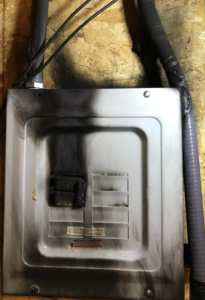
It obviously had been a raging inferno for a while.
IT DID NOT LOOK ANY BETTER INSIDE
Taking it apart, the breaker was totally destroyed, the wires to the transmitter still firmly attached, part of the breaker still firmly attached to the bus.
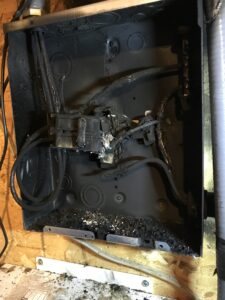
One of the feed wires from the 200 Amp box was still attached to the bus, the other melted to the neutral. Why it was not a total short circuit I really do not know.
The #4 wires in the conduit going from the 200 Amp disconnect were like new inside the conduit as were the #4 wires going to the transmitter and the 60 Amp breaker was not even tripped.
Apparently being a device meant for home use, it was unable to handle a 38 Amp load on a continual basis. Home use for things like heat, AC, ranges, water heaters, clothes dryers, and so on are all intermittent duty so the breaker has a chance to cool whereas running an FM transmitter 24/7 never lets it cool so it heats until it actually catches on fire as this one did.
We killed the power at the 200 Amp disconnect, and removed the old box and all of its wire. The flakeboard behind the box was badly burned and charred so the box must have gotten red hot.
It all was replaced with a real 60 Amp fused disconnect and it has been fine since.
ANALYZING THE MATTER
It is worth noting that the problem seen here is not only confined to circuit breakers.
I have had similar melting of fused disconnects because the switchblades lose their spring, overheat and lose more spring, and eventually the whole switch assembly turns into a blob of plastic. But I never had one of those actually ignite like this circuit breaker did.
Any future installations will carefully avoid consumer grade electrical parts.

WHEN POWER FROM THE POLE GOES SIDEWAYS
While we are here, I would like to mention another issue with AC power that happened at a rural site.
This site also had a 5 kW FM transmitter and a phase converter. After a hefty thunder storm, I was called and told the site was dead – no remote control, no carrier – so I made my way there. When I arrived, there was no AC power.
Now, this site had a 200 Amp single-phase fused disconnect on the outside of the building. The wires from the service head went to a pole which had a CT kilowatt hour meter on it. Then the triplex ran about 250 feet to the pole-mounted transformer.
THE METER SAYS WHAT?
Next, I looked at the electric meter and, although we had no power in the building, it was spinning like a top.
All I could think was “Where’s it going?” and “Why is the meter spinning???”
Then I took the cover off the panel in the building and discovered the problem. Both sides of the AC line had burned through and were welded to the conduit coming through the wall. It was a dead short – not only phase-to-phase but phase-to-ground.
The old transformer on the pole was just cranking out power like there was no tomorrow.
A DIFFERENT PROBLEM WITH AN ODD CAUSE
Apparently the 250 feet of service drop had enough impedance that you could not get 200 Amps out of the service, so the fuses had no reason to blow.
Therefore, the circuit just kept heating up the service cable from the transformer, through the meter CT, to the building through the fuses and switch to the short.
The power company came and killed the primary. The electrician came, replaced the burned wire, and replaced the fuses with 150 Amp fuses. The power company had measured the current before they pulled the primary and found it was 180 Amps – so if it should ever happen again, the new 150 Amp fuses will let go before the fire starts!
Sorry I cannot tell you how many extra kilowatt hours that station had to pay for – but it was a noticeable charge on the bill the following month.
– – –
Ron Schacht (K3FUT) has been a radio engineer for over 60 years, during which he has built something like 100 stations, including a dozen with directional antennas. You can connect with Ron at:screamingeagle@wctatel.net.
– – –
Would you like to know when more articles like this are published? It will take only 30 seconds to
click here and add your name to our secure one-time-a-week Newsletter list.
Your address is never given out to anyone.