
The World’s Most Heralded Radio Failure
[December 2025] This week we saw the 124th anniversary of an event that may not have happened. The late Don Kimberlin took a deep look into what he called the myth of Marconi’s success. You may find the story interesting for several reasons.
Much of today’s world is blithely ignorant about the origins of the “wireless” devices that have such an impact on our life and society. On the other hand, educators and archivists have ingrained in their minds this “fact”: Guglielmo Marconi spanned the Atlantic Ocean with radio signals on December 12, 1901 at 12:30 PM Atlantic Standard Time. Marconi told the world he heard the Morse Code letter “S” transmitted from Poldhu, on England’s Lizard peninsula, near Land’s End.
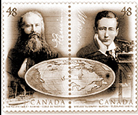
That Marconi must have succeeded has long been taken as an article of faith and reinforced to succeeding generations by those presumed to hold the truth of the matter. Details are widely published and accepted, and the claimed feat has been memorialized with monuments and even commemorative stamps and coins.

Indeed, for many, doubting the veracity of Marconi’s claim is technological heresy.
WAS IT REALLY SO?
However, a few nagging details have never been validated. First, no one who could be called an impartial observer was present at the claimed feat. The only other person at the receiver in Newfoundland was George Kemp, Marconi’s close personal assistant of several years. Second, Marconi himself could not state with certainty just how the signals could have reached the 2,100 miles across the Atlantic.
Furthermore, little was known then about radio wave propagation. Details like frequency, power level and antenna efficiency were not measurable at the time, and no detailed drawings or specification documents exist from which to reconstruct such facts.
This article does not claim Marconi to be a hoax. Indeed, Marconi probably did believe he heard the Morse “S” across the ocean. Still, there is now reason to believe Marconi heard something similar, but not the actual signal he wanted to hear.
EARLY DEVELOPMENTS
If it had not been for Marconi’s Irish mother, Annie Jameson Marconi, radio and wireless likely would have followed a different path. When young Marconi succeeded in 1895 by sending a meaningful signal over a hilltop to his brother on the family estate in Bologna, it was Annie Marconi who realized her precocious son was onto something important. First, she sent her son to the Italian post office to offer his discovery.
However, in typical bureaucratic fashion, the teenaged Marconi got his first hard life lesson. Italian government employees hit him with the same questions that have daunted innovators since time began: “Who are you? What are your credentials? Who sent you here? Why should we pay attention to you?” and so on. They could well have kept matters to themselves, pushing any development in typical bureaucratic fashion.
When young Marconi described his reception to his mother, she decided to take him to England where the Jameson relatives (of Irish Jameson whiskey fame and wealth) had money and influence. Nevertheless, on arrival in England a skeptical British government customs inspector took one look at the youthful Italian, eyed his baggage full of electrical items, and asked “Are you a terrorist? Is this material for a bomb?” Marconi’s mother is reported to have said at the time, “It’s not a bomb as you understand it, but it will blow down walls between men.” Such was the resolve forming in the Marconi mind.
Once in England, the Jameson influence did work, but not as hoped. Everyone seemed interested, but no one would join in the effort. Young Marconi was sent here and there to demonstrate endlessly, proving over longer and longer distances, and to try to overcome skepticism and denial at every turn that his innovation had practical value. Or, as he also found, whatever he sought to commercialize was something to which the government laid claim.
He finally found the government had no claim to merchant shipping on the high seas, and began to develop wireless for shipboard use. From that emerged the Marconi Wireless Telegraph Company, one of the few business entities Marconi would be able to retain as his own over many years. However, in those early years, it was not very profitable. Clearly something else was needed.
MARCONI’S NEED FOR SUCCESS
In 1901, at the end of five years of whirlwind development and demonstration, Marconi had gone through two rounds of family financing, and a refusal of the Jameson interests to pour more money into young Marconi’s seeming toy seemed ever more likely. Meanwhile, government subsidized wireless developers in other nations were making slow but steady progress. If Marconi did not have a “hit” – and a large one – soon, his budding empire might fail financially.
His wireless experimentation and shore station building placed him in close proximity to the then fabulously wealthy and successful submarine telegraph cable companies. In both England and Ireland, these had managed to evade government hegemony because their geographic reach and capital expense went beyond that of governments.
In mid-1901, when he found signals from his Poldhu transmitter in England were received very strongly at his Crookhaven marine station in Ireland, he realized sending international telegrams by radio was a business at which he could economically enter and undercut the submarine cable companies. Secretly committing 50,000 Pounds Sterling (approximately 3.1 million Pounds or 5 million US dollars in 2003 money) to his project, Marconi set about to build a wireless station on Cape Cod.
Even the forces of nature seemed against his endeavor. Winds at Poldhu and Cape Cod blew down the wooden antenna structures on both side of the ocean. A simpler replacement structure was built hurriedly at Poldhu and Marconi decided to try a last-minute receiver rig with a long wire antenna flown from a kite in Newfoundland.

It was December, and frozen gales were blowing atop the barren bluff called Signal Hill overlooking St. Johns, the town where many of the transatlantic telegraph cables landed. Still, it was convenient for Marconi to send cablegrams back to Poldhu to coordinate the tests. (Of course, the cable company employees could read and report every action of this potential competitor to their superiors as well.)
In a small, unheated barren room of a derelict military hospital atop Signal Hill, Marconi and Kemp kept a listening watch with earphones on the schedule they set via cablegram to Poldhu. At Poldhu, Ambrose Fleming (later to become famous in his own right for inventing the thermionic diode vacuum tube) was keying the single Morse Code letter “S” on schedule.
THE MYTH DEVELOPS
After some days, no signals had been received. Failure seemed imminent. Marconi kept trying different arrangements of the few simple pieces of apparatus. Finally on December 12, he removed components that would have amounted to a low pass filter, and shortly after mid-day, he heard what he thought was a Morse “S” in the earphones.
From the account, it would seem what Marconi heard was an HF component or components of the Poldhu signal. If it could be assumed the path had been working previously, then higher frequency signals must not have been getting through the effective filters of the Newfoundland receiver. In other words, Marconi (and Kemp) must have heard some sort of “shortwave” signals that day.
Because everyone wanted to believe, a rationale developed a few months later. American physicist Arthur Kennelly theorized in early 1902 that perhaps Marconi had some signal reflected off an ionized layer in the upper atmosphere. (No one really knew how to calculate path losses nor what ionospheric “skip” propagation was.) Oliver Heaviside in England concurred with the Kennelly theory, and the rationale that Marconi must have heard some HF components was generally accepted.
Marconi and Kemp were certain they heard the three dots of Morse Code “S” that day. And the mythical theory has been taught as a canon of technology ever since. But no one has taken the time to see if indeed an HF radio path existed on the famous day.
A SECOND LOOK
Many years later, Marconi estimated the frequency of the Poldhu transmitter was somewhere in the range of the lower end of today’s medium wave AM broadcast band. With what we know about lower frequency propagation today, any groundwave signal would have attenuated down to a few picovolts, a signal that would challenge even the most modern of receivers to pick up out of natural noise.
Using a photo of the Poldhu transmitter antenna current-day antenna specialists confirm this, estimating it was a rather effective low-pass filter cutting off everything exceeding about 850 kHz. Thus, even if the Poldhu spark created all the spurs and harmonics we are told spark transmitters generated, only those signals below 850 kilohertz would have been radiated anyway. There would have been no HF “shortwave” components to “skip” across the ocean!
But over the years, the academic community has not taken into account a major fact about December 12, 1901: it was the lowest of “low days” for solar activity needed to create skywave “skip” transmission across the Atlantic on any frequency. In fact, the sunspot count on that fateful day was zero, leaving the solar flux at its background level of 64. Try any of today’s HF propagation programs to see if you could get a path between Poldhu and St. John’s with a zero sunspot count. It would not work even if you did have a transmitter radiating some HF signals.
Furthermore, you can forget about “grayline” propagation, too. At 12:30 PM Atlantic Standard Time on 12/12/1901, neither a short path nor a long path “grayline” was in reach of Newfoundland, and it was only marginally approaching Poldhu. Like the propagation issue, the grayline one can be readily seen by setting the clock of a grayline program to the famous day and time.

WAS MARCONI A HOAXER?
In a word: no. Lawyers tell us witnesses do not lie. They do, however, selectively use memories to create the story that suits their belief. It is the prime reason the Vatican runs such long and detailed investigations of claimed miracles; not because people want to hoax the church, but because they can believe so strongly they create a whole story out of distorted facts.
Here is a fact usually ignored by the perpetuators of the Marconi Myth: to conserve his dwindling resources, Marconi had Fleming purchase the largest used alternator available for Poldhu. Concerned and fearful of damaging this unit, they tuned its spark gap to the shortest possible duty cycle. This meant the sound of the Poldhu transmitter was not the characteristic “buzz-buzz-buzz” we are taught to expect of spark transmitters, but rather Poldhu produced a “click-click-click” like a wireline telegraph sounder.
The sound Marconi and Kemp were listening for was three clicks, not three buzzes! And three clicks were the sound they heard. But the three clicks could not have made the trip from Poldhu to Newfoundland. There simply was not a radio path for such signals between those two places on the planet on that day at that time! I do not doubt Marconi heard something. But it was not transmitted from Poldhu.
However, there was a source of “click” sounds existing on 12/12/01. It existed then, before then and exists to this day. It is the approximately 8 million lightning discharges occurring worldwide every day. At any given instant, there are an estimated 1,800 thunderstorms occurring around the world. We all have heard the crashes and sometimes the clicks from lightning.
Moreover, the nature of lightning is of a rapidly pulsating spark producing noise from LF well up into the HF spectrum. (Indeed, we today notice “static” from lightning in VHF television channels 2 through 4, meaning up to 70 MHz or so.) This means we can expect and do find undesired HF artifacts of static propagating around the world to great distances, just as do desirable HF radio signals. Such static heard on a “shortwave” receiver may have originated on the other side of the earth. More likely, the HF static crashes and clicks we hear are transiting some better, easier path. In terms of HF radio, those better, easier paths are north-south paths, not the east-west path Marconi was hoping to use between Poldhu and Newfoundland.
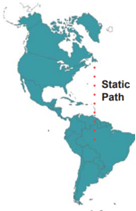
Similarly, the HF static we hear likely originates from one of Earth’s three major lightning storm epicenters: Southeast Asia, Central Africa, or Amazonian South America. Hence, it is very likely Marconi heard that, too, because a brief look at the map shows Newfoundland is pretty much directly north of the South American lighting epicenter!
SUMMING UP
So, the final answer is no, Marconi did not hear his Poldhu transmitter on December 12, 1901. What he most likely did hear was clicks from lightning originating in Amazonian South America, a place situated for perfect transmission of the shortwave components of lightning static to Newfoundland.
Marconi’s claim also violates one of the principal laws of scientific reporting: he was never able to reproduce the results. In fact, it took several more years for Marconi to successfully make a reliable, reproducible wireless link across the Atlantic. To do so, he had to reduce the transmitting frequency twice, from the approximately 800 kHz of 1901 to attempts in the 100 kHz range to finally build a link that operated at 30 kHz in 1906, using monstrous 300 kW transmitters at Clifden in Ireland and Glace Bay in Nova Scotia.
Marconi was no charlatan. He was no hoaxster. On 12/12/1901 he desperately needed a success, and on 12/12/1901 be honestly believed he had achieved it. Neither Marconi nor anyone at the time could have suspected there would be another “signal” sounding like the one he wanted to hear, much less where it would have come from or how it would get to Newfoundland.
We have since learned all those things and more about the nature and management of radio waves. For that, we owe Marconi eternal gratitude for the spread of industries and technologies his dynamism and efforts spawned in such a short time. If there had been no Marconi – if radio had developed at the hand of governments, which would have been its other course – it might have taken many decades more for us to reach the level of productivity, economy and convenience we all enjoy with “wireless” today.
References:
You can read more about how later technologists have analyzed Marconi’s 1901 transatlantic radio attempt at:
https://www.radiocom.net/Fessenden/Marconi_Reprint.pdf “A Radioscientist’s Reaction to Marconi’s transatlantic Wireless Experiment – Revisited, by John S. Belrose, a leading radio investigator. This paper also contains numerous excellent further references.
If you would like to see for yourself what the radio paths were like on December 12, 1901, download the excellent program W6Elprop, a Windows version of the well-known Miniprop by the same author. Get W6Elprop free at: https://www.qsl.net/w6elprop/ (simply put in 0 for the sunspot count or 64 for the solar flux on 12/12/1901.
– – –
The late Don Kimberlin was a long-time broadcast engineer and was NARTE Certified. He wrote on many technical topics, both current and historical, and loved to go hunting for history.
– – –
Would you like to know when more articles like this are published? It will take only 30 seconds to
click here and add your name to our secure one-time-a-week Newsletter list.
Your address is never given out to anyone.