
Broadcasters’ AC Problems Solved with PowerClamp

[March 2026] Whenever a broadcast engineer sees a lightning storm, the first thought that comes to mind is about the tower at the transmitter site sticking its “nose” into the atmospheric display of natural power. A little less obvious but important, is the effect on the incoming power grid. Is there anything that can protect the transmission operations from these outside impacts.
Broadcast station transmitter sites are expected to be virtually 100% reliable even though they are unmanned and usually exposed to a myriad of issues that affect reliability.
HOW AC POWER CAN BE A PROBLEM
However, one of the most common risk factors is the quality of the AC power that operates the facility.
Transmitter sites are often on hilltops or in rural areas, at the end of a very long run of powerline wiring. This wiring becomes an “antenna,” picking up electromagnetic pulses caused by lightning.
Voltage spikes and surges can also be caused by other power customers, especially industrial users that utilize heavy equipment.
HANDLING THE PROBLEMS
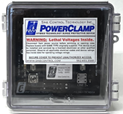
PowerClamp Surge Protective Devices, or SPDs (formerly called “TVSS”.
Transient Voltage Surge Suppressors are designed to deal with these two dissimilar issues in a unique and very effective way.
PowerClamp has two discrete surge suppression circuits that are tailored to these two types of powerline disturbances. The two circuits operate in tandem, responding to both Voltage/ amplitude and pulse width/duration.
Spikes: High Voltage lightning-induced spikes are handled by Metal Oxide Varistors (MOVs).
These function like a peak clipper in an audio limiter. PowerClamps MOV circuit has the “clipping threshold” set sufficiently high so that only high Voltage spikes will be attenuated. The MOVs never conduct during normal line Voltage levels (nor low-level surges).
Surges: The second suppression circuit responds only to longer-duration Voltage surges.
Although these lower Voltage surges may be “only” a few hundred volts above normal line Voltage, they occur much more frequently, often dozens or hundreds of times per day. Their cumulative effect is often equipment damage or circuit breakers that trip for no apparent reason.
Using our audio analogy again, this second circuit operates like Program Controlled Attack in an audio limiter. It senses the wider pulse width, and reduces lower Voltage surges to levels that are just a few Volts above the normal peak value of the AC sine wave.
CONTINUED PROTECTION
Another advantage of this two-pronged approach is that the PowerClamp’s performance does not degrade over time or use. Even after thousands of “hits,” its Clamping Level stays consistent, remaining as effective as when it was first installed.
This continuous protection is available because PowerClamp units are installed in parallel with the incoming AC power.
Because the unit is not in series with the load (transmitter), there is no Voltage drop, and no need for “load matching.” Spikes and surges are instantly shunted to ground before they can cause equipment damage. In the (unlikely) even that the PowerClamp overloads, it will blow its internal fuse and take itself offline – but AC power will remain on and the transmitter will stay on the air.
PROBLEM SOLVED
Here is what Tom Koza, (retired) Chief Engineer for KPWR in Los Angeles reported:
“At KPWR, our FM transmitter would occasionally trip breakers and go off the air without any obvious cause. I had installed a PowerClamp unit at KWVE a few years earlier when they had a similar problem, so I installed one at KPWR.
“The PowerClamp unit solved the KPWR problem immediately.
“Since then, I have installed PowerClamp TVSS units at KSCA and at KLVE (both in Los Angeles). I made it my ‘standard operating procedure’ to install a PowerClamp unit at any transmitter site I’m responsible for.”

ANOTHER PROBLEM JUST DISAPPEARED
Newer generation transmitters use switching power supplies, which are easily damaged by powerline spikes and surges, as Bob Sousa’s experience at KCKM illustrates:
“In the first 3 years owning KCKM 1330 in Monahans, TX, I spent a great deal of time changing MOSFET’s in my 5kW solid state transmitter. Our site is in the middle of a very active oil field, surrounded by “pump jacks” cycling on and off around the clock.
“We installed a PowerClamp, wired it to a breaker on the electrical panel, and turned it on. Did it solve the problem? You bet! It’s been 14 months since I replaced a MOSFET.”
DESIGNED FOR ITS JOB

PowerClamp Series 200 units are designed specifically for broadcast transmitter sites, and are rated at 200,000 surge-amps per phase.
They are available for single phase and 3-phase power, and all standard Voltages up to 480 Volts.
– – –
For more information, visit https://henryeng.com/powerclamp/ or contact Hank Landsberg at Henry Engineering/Sine Control Technology at (562) 493-3589.
– – –
Hank Landsberg is the President of Sine Control Technology, a division of Henry Engineering. You can reach out to Hank at: henryeng@aol.com
– – –
Would you like to know when more articles like this are published? It will take only 30 seconds to
click here and add your name to our secure one-time-a-week Newsletter list.
Your address is never given out to anyone.