

The Quiet After WABE: A Reflection on Our Industry and Its Future

[December 2025] Trade shows are an important part of the industry. For many in the US, the NAB Spring Show has been the touchstone for the industry. But we do have neighbors to the North in Canada. The Western Association of Broadcast Engineers (WABE) has been going for 75 years. No, not as big as NAB, but just as important for the folks in the region. Tessa Potter has been the President of the WABE and here she reflects on the 2025 WABE Conference, as well as issues that affect us on both sides of the border.
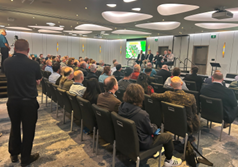
The quiet after seeing over 375 of our friends at the WABE Media and Entertainment Technology Conference in Calgary this past month is finally setting in.
It is time to plan our next Annual General Meeting, look forward to the future, and decide the city to which we are headed next. For our volunteers and the entire community that supports us, there is pride in knowing that gathering across Western Canada continues to have real value. It is beneficial for businesses big and small to connect with vendors in broadcast, radio, television, post-production, pro AV, film and live staging, and to have a space to come together beyond the workplace.
A REGIONAL SHOW BRINGS PEOPLE TOGETHER
Many attendees were impressed with over 60 vendors onsite and by the opportunity to meet sales teams representing different manufacturers.

Not everyone travels to large shows like NAB or IBC, so having vendors come to Calgary to meet professionals where they do business meant a lot. It allowed sales teams to see familiar faces, meet new ones, and reconnect with their resellers, all in one place. This is why we still believe in the importance of regional industry shows.
We are growing, and we love showing our new friends from outside the traditional broadcast community that they are welcome to come talk tech alongside those who know the craft deeply.
TEAMWORK IS THE KEY
Most of my career has been about teamwork.
In live production, television, or radio, no one works alone. Every project relies on people with different skills, personalities, and strengths, and that diversity is what makes it work.
That is also what makes the environment demanding; each team member contributes something unique and irreplaceable.
CONSTANT QUESTION: WHERE ARE THE NEW TECHS?
As an association leader, I know that part of the challenge in our industry is that many of us work long, unpredictable hours. Broadcast technicians, for example, support 24/7 operations and are often on call.
While remote monitoring and maintenance help, most of our time is consumed by work, leaving family and personal life to fit into whatever space remains. It is a dynamic, always-on environment, and it can make it hard to pause, share stories, or connect with others about what we do.
The declining enrollment in radio, television, and media programs is a topic that comes up often, and it struck me that I am asked more about the next generation of workers than about AI or automation in media and entertainment.
Hearing that media programs are struggling to attract students is worrying. Behind the scenes, technical roles are critical, and if these programs disappear, the entire industry will feel it.
THE CHALLENGE: STAYING CURRENT
Media and entertainment are not like plumbing, where standards stay the same.
The tools evolve, but the fundamentals like editing, sound, storytelling, journalism, and production craft remain essential. Students still need to learn how to capture, assemble, and tell stories through audio and video. These are timeless skills that power everything from news to streaming to live events.
One of the biggest issues I see in attracting new talent is the lack of junior positions. Companies need to create entry-level jobs, post them publicly, and connect with institutions early so that students can find a path into the industry. Without these roles, the pipeline dries up.
Another issue is that small production houses and corporate environments are building studios and media systems but often do not know the skill sets they need. Many of these roles end up in IT departments or installers, where staff may not have the background to manage audio, lighting, cameras, or broadcast workflows.
There is no question that IT knowledge is essential, but media and entertainment technology also require creative and technical flexibility that goes beyond standard network administration. Production systems do not behave like office networks; they involve complex, proprietary tools that need to communicate and adapt dynamically to creative needs.
So, what can we do right now?
FOSTERING THE NEW BROADCASTERS
If you work in media and entertainment technology, take five minutes to give your alumni a shout-out.
Post on LinkedIn, tag your institution, and let them know that the program you took is still valuable and that the fundamentals you learned continue to support your career. Take an afternoon and invite a local school with a media, broadcast, electronics, or film program to tour your business and have staff spend a few minutes talking to students about the work you do.
If you run a business that creates or distributes content, start using job titles the industry already uses, “Broadcast Technician” or “Producer,” and you will see more applications. Even part-time or contract roles can attract skilled people who know how to integrate cameras, lighting, audio, and IT. Do not create new job descriptions that miss the mark; use titles people in the field recognize. There are mid-career professionals with decades of experience ready to take on new challenges, and small businesses can benefit from their expertise and their desire to do something new.
Across Canada, more organizations are building production environments, adopting streaming workflows, and creating content even for their internal company audience. Yet, many still do not realize they need someone with a broadcast or media tech background to make it all work.
Integrators can help with installation, but long-term support requires in-house expertise.
[the_ad id=”2906″]
WABE FOCUSES ON INDUSTRY NEEDS
At WABE this year, we heard from the Fokus Fraunhofer Research Institute that 80% of all Internet traffic is streamed media.
That statistic alone should make every educator and policymaker pay attention. Content creation, storytelling, and technical skill in audio and video are more relevant than ever.
To educators: If your broadcast or media program is struggling, share this with your dean. We need your students. We need these programs. Technology will change, but fundamentals matter. If you teach storytelling, audio, video, and journalism, your program is still essential.
To students: Do not give up. Reach out directly, send your résumé, and tell people you want to work in this field. Persistence still matters and, if the HR abyss has you discouraged, going back to dropping off a paper resume is still worthwhile. This industry rewards curiosity and determination.
THE VIEW AHEAD
Looking ahead, I am excited about what we see in the next decade.
There are incredible projects emerging and workplaces waiting to be built. The industry needs students, mid-career professionals, and senior experts alike, and we all need to support the institutions that teach the fundamentals.
If most of the world’s internet traffic is now video and audio, storytelling is not going anywhere. It is growing, evolving, and becoming more essential every day.
– – –
Tessa Potter has served as President of the WABE for the past three years, after two years as Secretary. A veteran of over 25 years in the industry, Tessa is a Senior Broadcast Technician for Sound Broadcast Ltd, where she helps maintain radio and TV transmission sites. Her other work includes engineering support for the Winnipeg Jets hockey team, and she will be part of the NBC team for the upcoming Olympic games in Italy. You can contact her at: https://www.linkedin.com/in/tessapotter/
– – –
Would you like to know when more articles like this are published? It will take only 30 seconds to
click here and add your name to our secure one-time-a-week Newsletter list.
Your address is never given out to anyone.