

You Cannot Make This Up!
By Mike Langner
[November 2026] Broadcast engineering has definitely changed over the years. Instead of a tube-based transmitter (remember the glowing tubes?), we have solid-state transmitters than, in some cases, are just a couple of rack spaces. Instead of a studio with all sorts of audio gear, we have a computer. Mike Langner has been a Chief Engineer and an ABIP Inspector in New Mexico for over 5 decades. With his experience he can tell you stories. In fact, he will:
Most engineers who have worked for a long time, have been at least one station where the management was so cheap, it was like a Johnny Carson joke.
The GM at one AM station I took care of early in my career was so cheap.
HOW CHEAP WAS HE?
He was so cheap that when the station ran out of money, he quit paying me my little $150/month contract engineering fee. So, I stopped working for it.
About a week after I was no longer the contract CE, the station called saying it was off the air – cycling on and off the air about once a second – and could I possibly find it in my heart to help them one more time.
DIAGNOSIS
After a heavy sigh, I drove out to the site, looked at the transmitter, and figured something must have become loosened in the spring winds, much like the ones we have been experiencing here recently.
Applying the standard “fix the intermittent cure,” I hit the side of the transmitter with my fist. The intermittent at least temporarily cured, as the station was back on the air properly.
THE FIX
I most certainly had enough of the GM’s way of doing business.
However, being unwilling to return to that mess again, I took a page of transmitter log paper, wrote in big print,
“If overloads oscillate, hit the transmitter really hard right here!”
I taped the page to the side of the transmitter, just above a big smudgy circle I put just under the notice.
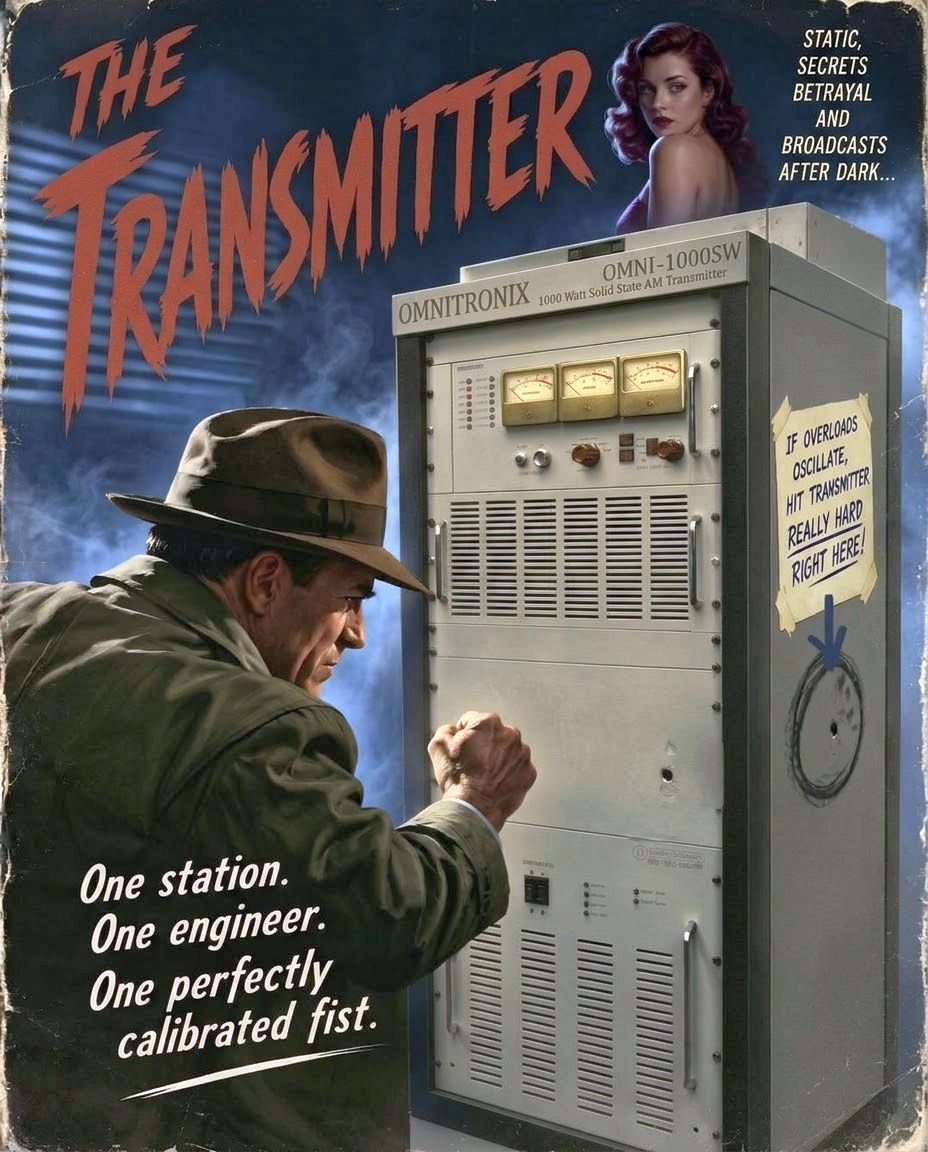
Courtesy: Ken Fine
And then I left the site, never to return.
= = =
THE LITTLE STATION THAT COULD ROAR
Another experience I had was in the late 1960’s.
I was the CE of that AM-FM combo, KDEF. The AM was 5 kW ND / 0.5 kW DA-N. The FM was negligible – 1.6 kW horizontal only at approximately -175 HAAT. Clearly it had been purchased just to get and hold the license.
That year the little KDEF purchased the University of New Mexico Lobo Sports contract – a contract that the 50,000 Watt KOB had held for years. In return, the KOB folks were determined to show that little KDEF and its little 500 Watts at night was not in Lobo Sports interest and they would soon get the contract back.
500 WATTS AGAINST 50,000
KDEF (that’s me) had a few tricks up its sleeve.
First, to get near statewide coverage, we got a number of small-market stations to take the KDEF Lobo games feed. So much for wide area coverage. But what about Albuquerque listeners. 500 Watts was sure lots less power than 50,000, and would sound much weaker!
KOB got wind that the KDEF manager had asked me to “turn up the power” during the first game when UNM Lobo sports officials would be listening. While I could not prove it, I expected that KOB would have set up a field strength meter or two to report us if the station did “turn up the power.”
LOOKING FOR A MIRACLE
It was Game Day and then game-time came. Lots of listeners were tuning in, including the KDEF manager who had demanded that I “turn up the power.”
And then, a miracle happened.
As the manager listened the station got very noticeably louder. KOB’s folks (I presume) watched their field strength meters. But, the field strength meters did not budge.
How could this be?
Trivially simple.
A LEGAL SOLUTION
I just cranked up the input to the audio processor so far that it became a real “squasher” and was also clipping the audio. With the program material now no longer being music, but was the strident
play-by-play announcer accompanied by lots of crowd noise, the clipping was not audible to the lay person’s ear. In fact, the “pumping” of the crowd noise added “excitement” to the audio, making it seem even louder.
It has been lost to my memory whether or not the Lobos won the game, but KDEF won the loudness war.
… and kept the Lobo contract for years.
= = =
WHEN THERE IS NO ENGINEER IN SIGHT
In recent years, I have travelled far and wide around the state with the ABIP (Alternate Broadcast Inspection Program). That has led to a number of really interesting engineering stories – usually at a station where there was a lack of real technical knowledge.
For example: Shortly after an AM station I visited added an FM station, I was asked to make an ABIP visit to the AM-FM operation.
At the FM transmitter there was no frequency monitor nor any record of ever having had a frequency check done. I asked on “engineer” how he would know if the FM station was within plus or minus 2 kHz of its assigned frequency.
His response: “”Well, as you can see, this is one of two diplexed FM transmitters. Since the diplexer won’t allow anything off frequency from going through it, it has to be within tolerance or it would go off the air.”
THE TRANSMITTER IS LOCATED WHERE?
At an AM station I visited, there was a staff member, not an engineer, who was the designated Chief
Operator.
During the inspection, we went to the transmitter site. When we got there, I expressed a little bit of surprise that the tower was several miles closer to town than the license said.
“Yes,” said the CO, “We moved the station to this tower since it’s closer to town and everybody can hear it better.”
I asked if the station had notified the FCC.
“No,” replied the CO. “Do we have to?”
,,, and, no, that station did not get a certificate of compliance from the ABIP.
= = =

WHEN THE ROUTINE MAINTENANCE PROGRAM FAILS
Finally, there was a station I was to inspect in the southern part of the state.
The contract engineer was not available that day, so the manager and I went out to the AM
transmitter to read its base current.
Although the manager said the contract engineer visited the site weekly – it was part of the engineering agreement – it was pretty clear there was no evidence the contract engineer had been there in ages.
NO HOUSEKEEPING ON SITE
When we opened the door to the tower base tuning unit, it was extremely dusty.
I expressed to the manager that it looked as if the meter had not been read in ages, given the dust and dirt on the meter and the components inside. In fact, I suggested that it might be better not to try to read the meter right then, since a good cleaning, particularly of the meter switch and the external RF
ammeter thermocouple assembly as well as the meter itself would likely be a good idea.
DO YOU REALLY WANT TO DO THAT?
“He says he reads it every week,” said the manager, so let’s go ahead and read it.”
It was not my job as inspector to do so, so I showed the manager how pulling the meter switch plunger would activate the meter.
And then he pulled the plunger.
NOT THE RESULT DESIRED
The meter immediately caught on fire, the meter hand pinned, and the meter case cracked, resulting in the station going off the air.
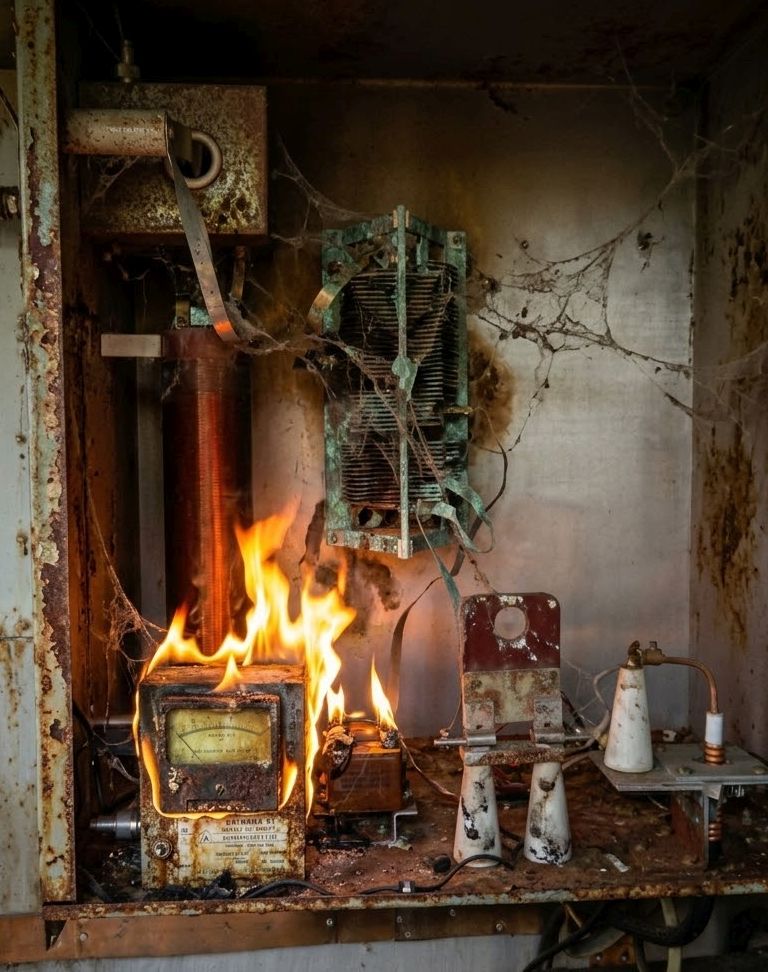
Courtesy: Ken Fine
I suggested that the manager push the meter plunger back in. We then walked across the radial field to the transmitter building, hit “reset” on the transmitter, and put it back on the air. I further suggested that the manager have a talk with his engineer about what we had experienced.
Oh, yes, and the log? It was nowhere to be seen. The manager explained to me that the engineer kept it in his car.
And, no, this one did not pass the inspection either.
– – –
Mike Langner has inspected a state full of radio and TV stations, and has seen everything from clean sites, fully compliant with the FCC Regulations to another group – where maintenance only happened when the station popped off the air. Fortunately, the majority accepted his recommendations and brought things into compliance. Sadly, a few never learn. You can contact Mike at mlangner@swcp.com
– – –
Would you like to know when more articles like this are published? It will take only 30 seconds to
click here and add your name to our secure one-time-a-week Newsletter list.
Your address is never given out to anyone.