The BDR

The
Broadcasters' Desktop Resource

... edited by Barry Mishkind - the Eclectic Engineer    

Digital Alert Systems

Information on EAS - CAP - IPAWS - FEMA

The idea is to bring some clarity to the issues and answer your questions. Definitions and
a fair amount of historical info is below, including air checks from the National EAS Test.
(Last update 5/14/13)

5/14/13 - A number of stations reported intermittant CAP service today. It was across the country, but it appeared that only a portion of stations were affected.

5/2/13 - The PSHSB (Public Safety and Homeland Safety Bureau) of the FCC has issued a statement encouraging the SECC's to update their state plans and monitoring assignments. An outgrowth of the recent report on the National EAS test, the FCC wants SECCs to review Section 11.21 and ensure it is up-to-date. Some changes may only need informal latters.

5/2/13 - The FEMA and Premiere Networks are working on a plan to provide an additional data path to stations from the IPAWS OPEN server. A date for implementation has not yet been announced, but most observers see any additional options for receiving the CAP messages is good for the industry.

4/18/13 - The IPAWS CAP server was down today from 7:59 to 8:16AM EDT

4/12/13 - You may breath again! All those of you who have been holding their breath, waiting for the FCC's report on the National EAS Test. It was released Friday - just after the NAB Spring Show.
               Highlights:

  • The FCC called the test an overall success.

  • Audio quality was poor due to a FEMA connection issue.

  • 13,787 broadcasters reported - and 83% said they got it and relayed, even though the audio was poor.

  • Three PEP stations did not get the test, and those regions missed it.

  • The abrupt shortening of the test made it less useful for diagnostics.

  • Some EAS boxes did not perform as expected, but did as mandated.

  • Another national test is needed.

  • Additional audio paths need to be explored.

  • A number of monitoring assigments were apparently not correct.

  • The FCC needs to move to get Part 11 updated, and receive updated State and Local plans filed.

  • The FCC suggests initiating a web-based reporting system for EAS tests.

3/13/13 - Monroe Electronics and Digital Alert Systems have delivered the first CAP-enabled receivers for Canada's multilingual NAAD (Net Alert Aggregation and Dissemination) system. Fully functional in English and French-Canadian, the DASDEC and R189 One-Net systems can provide CAP-driven audio announcements for weather alerts and civil emergencies. The DASDEC now handles English, Spanish, and Canadian-French.

3/11/13 - The IPAWS CAP server was reported up and down this morning, for example: from 8:25 to 9:22AM EDT and 9:31 to 9:42AM EDT.

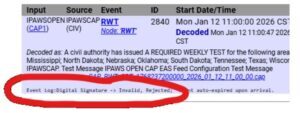
3/7/13 - This past Monday's RWT from the FEMA was not received by some users with DASDEC EAS receivers. The focus on what happened is on a minor issue with the scheduled software update that was made to the IPAWS aggregator last week.

If you did not get the test, just note it "failed" and determined that it was not a local problem.

Broadcasters should not be unduly worried at this point, as a software update will certainly be forthcoming to fix things. Whether or not everyone will receive next Monday's RWT from the IPAWS CAP server as usual will depend on how things are handled.  More information will be posted as available.

3/6/13 - TFT has received Certification from the FCC on their new EAS911+ CAP-enabled EAS receiver. The unit has also complete FEMA compliance testing for CAP decoding. TFT will be showing the product at the NAB Spring Show next month.

3/5/13 - Another movie trailer - for "Olympus Has Fallen" - is running around the country with EAS tones included. While the tones have not yet been reported to contain any useful information, it is a violation of 73.1217 - it may be worthwhile to inform your traffic/sales/management. (The producer is supposely doing a remake without the tones - but check which version you may be airing!)

2/28/13 - The FEMA has finally responded to many requests by the BWWG and others for delivering information on the IPAWS OPEN server status and the occasional issues. They have set up a mailing list which also will inform users of the status of the weekly tests, so users can compare with their local logs, and information on when problems occur. To sign up, go here. 

2/26/13 - A web seminar has been scheduled for Wednesday, March 6th to discuss the state of the public warning systems and how to improve them, especially on the state and local level. The time for the broadcast is 2PM Eastern time. The link to the broadcast is here.

2/26/13 - NPR is in the midst of a study to see how stations can better serve deaf persons with EAS messages. Methods may include strobe lights or vibrators actiivated by RDS signals.

2/26/13 - A scheduled outage of the IPAWS OPEN CAP Server has been announced for Wednesday 9:30 to 10:00 AM EST tomorrow (Wednesday) 2/27. There is to be a software upgrade.

2/25/13 - The FCC has renamed CMAS as WEA - Wireless Emergency Alerts.

2/12/13 - Here is a bit more of what facts we know about the fake EAS event Monday:

  • Of the six stations affected, all were either without firewalls or using improperly provisioned firewalls.

  • Of the six stations affected, all were still using the default password.

  • A threat by "Anonymous" to disrupt the President's speech on the Internet drove a lot of high level activity.

  • The vast majority of stations are not in any danger of attack in the same way.

  • SECCs, LECCs, the FCC, and the FEMA need to consider what other adjustments need to be made to provide a higher level of security to the entire EAS, and prevent a cascade "prank."

  • The main threat has been - and will continue to be - to the Internet connectivity of any business. If your company has not previously looked at the logs of "attempted entries" to your system, do so, and be enlightened. Remember: most stations now have some sort of IP connection for remote control, consoles, processors, and more. All of these need protection.

2/12/13 -

  • The intrusion was not a "general hack."

  • It was not an exploit of a known vulnerability.

  • It was a penetration into a station's network and then a logon into their EAS receiver.

  • It appears a YouTube video from 2009 (note the comments), was the source for the mp3 that was uploaded to the EAS box.

Key point: The unauthorized EAS device access and subsequent alert happened because the system was still using the factory default password. While no one has admitted to not having a working firewall, one station did claim that their attack was launched from another continent.

To repeat: While it has be indicated the event developed from a breech of a company LAN, the resulting on-air issue was due to the failure of stations to change the default passwords.

  • Please check your EAS box now and verify that the password has been changed!  

  • It would also be a smart thing to check your firewall to ensure it is operating properly to keep non-authorized personnel out of your LAN.

  • Do not connect your EAS box directly to the Internet.

  • If at all possible, do not place your EAS box on the same network as used by any air talent. All it takes is one Trojan Horse, and it is as good as having no protection.

  • If you are unsure of the above, the FCC recommends you unplug your EAS box until it is fixed.

Another problem popped up today. Several stations, and apparently NBC Today played the audio on the air, including the databursts. There have been scattered reports of stations relaying this. It is a good idea to ensure filters are set correctly (fips codes), and the relay time window does not accept outdated alerts.

2/11/13 - Have you changed the passwords on your EAS receivers from the default? If not, please be aware that hackers have managed to penetrate EAS CAP receivers in at least two states and put out a fake alert. Other stations caught it and blocked it in at least three states. Do not operate with your default password! A few sites have video/audio of the event.

2/11/13 - The FEMA advises us that the IPAWS OPEN Server still is intermittantly up and down at 6AM EST. It has been reported to be back up at 9:33AM EST, although some areas reported problems until 2:30PM EST

2/10/13 - The IPAWS OPEN CAP Server went down at 10PM EST.

1/16/13 - Lamar Smith (KDWN Las Vegas) was the latest to be added to the PEPAC (Primary Entry Point Advisory Committee), The ten member committee helps bridge the FCC and the FEMA with the PEP (Primary Entry Point) stations in each state.

1/10/13 - The FCC report on the Derecho storms last year have a couple of interesting points. While they "like" what the broadcast community does, the writers also appear to think 911 and other alerting methods like CMAS are the future. 

1/10/13 - A  presentation at NAB by the FEMA's Wade Witmer and representatives from NOAA and the cellular industry discussed the state of alerting, especially the current CMAS rollout. Some of the topics included the rather difficult time the cellular industry is having getting the right messages to the right subscribers.

1/9/13 - EAS ALERT: If you were wondering when the FCC was going to enforce the requirements for stations to monitor IPAWS OPEN CAP feeds, wonder no longer. An NOV was issued to KPRI, San Diego for not having records of monitoring the CAP feeds nor reasons why tests were not received.


Myat, Inc.


  It takes less than 30 seconds to sign up for the free one-time-a-week BDR Newsletter. Just click here.
Looking for the article index list?  It is right here - just click and see!

12/31/12 - Another IPAWS OPEN outage has been reported, starting around 9:30 AM EST.  It appears to have been completely restored by 2:30PM. The outages seem to be different in some areas. e.g. The MST Monday test was received normally.

12/24/12 - The FEMA IPAWS OPEN server was reported to be up and down approximately 8:32PM - 12:20 AM EST

12/20/12 - Another "rolling restart" was apparently done successfully.

12/17/12 - The FEMA plans a "rolling restart" of the ATOM server at 3 PM EST today.

12/14/12 - The IPAWS OPEN server is reported down at 4:24PM EST. Restoration appears to be at approximately 5:22 PM EST. What was described as a "rolling restart" process did not, and a manual restart happened. The FEMA is looking into what happened.

12/12/12 - The IPAWS OPEN server went down today, but without any advance notice, at 11:23AM EST. Complete restoration was finally at approximately 12:45PM EST.

12/11/12 - The FEMA has been doing an upgrade on the IPAWS OPEN server. It was supposed to take a few hours today (Tuesday), but late at night, there was information that there was a snag, and the installation of a mirror server would have to be done another time. The plan for an "active-active" system with rollover, is hoped to prevent any systemic outages in the future - one of the two servers always being active and an automatice "failover" going into effect in case of problems.

(Prior known outages of the FEMA IPAWS OPEN server are located here.)

10/29/12 - Hurricane Sandy smashed into the East Coast today. Few EAS messages were sent, as it was pretty clear this was coming and the wall-to-wall coverage on the TV nets and many "full service" radio stations pretty much informed everyone. On the other hand, the FCC and FEMA have other ideas on how you may wish to communicate - or at least some might think the priorities are a bit upside-down. At least they got to radio. Broadcasters should feel "special."

10/26/12 - The New Jersey Broadcasters' Association reports that the state's EAS systems suffered a major outage after a lightning strike caused major issues with new EMnet system. A backup trunked radio system also failed at the same time, prompting calls for more periodic testing to ensure both the EAS and backup systems were always ready.

10/15/12 - For those of you who wonder how tests of emergency alert systems work in other countries, perhaps it will provide a small sense of perverse comfort to know that having problems during national tests is not confined to the US.

IPAWS OPEN CAP and the RWT 

The FEMA has listened to requests from the BWWG and the broadcast community and announced the IPAWS OPEN RWTs will continue TFN.
 
These tests - scheduled for Monday at 10 AM local standard time (11 AM DST) for the main time zone in each state - will be initiated by the IPAWS OPEN CAP server each week

Exactly does it mean for a station to be "compliant?"
Each station must purchase, install, and make operative an EAS receiver capable of receiving CAP/EAS messages. The most important change from previous operation is that a station must be connected to the IPAWS CAP server and receiving data. That, of course, requires the new generation of decoders and a wideband Internet connection. At this time, none of the various state/area aggregator tests are required. This will change as state and local plans - or amendments - are filed with the FCC but, as of now, in most places, you are only adding the CAP/EAS to your existing state plan.

Do you have to log the tests from the IPAWS server?
Yes.  ALL TESTS FOR YOUR AREA that are received - and decoded - should be logged, according to the FCC. Tests from other states/areas that are not in your decode chart are not required.

If there is a problem with the IPAWS RWT tests, what should be done?
The FCC currently says that stations may just put "Did not receive RWT from IPAWS" or some such notation. If you know why there was a problem, add that. However, there is no urgent need to search out and log the reason. If we know of any IPAWS OPEN issues, we will note them above.

Will the FEMA have a web page to explain problems/errors?
According to the FEMA, not at this time. Their main concern is that you have a "connected" status. Beyond that, they will distribute information as available, but not necessarily on any schedule.

How often should you poll the IPAWS server?
Some suggestions range from every 30 seconds, to 60 seconds, to as long as 5 minutes. At this time it is up to the station. A slide on a FEMA presentation says 30 seconds. Some receivers default to 60 seconds. In the future, when state and local alerts may be transmitted by CAP, some may feel there is a need to be on the slower end of the scale, but many system experts say 30 seconds is too often.

IPAWS OPEN SERVICE CONNECTION TIPS 

The three most common problems for those installing new EAS receivers:
1. Make sure you have the most current software.  (Especially Sage owners)
2. Have the IPAWS server name (FQDN) entered in the setup.
3. Ensure your firewall will allow you to poll the server.

If you still have issues, contact your receiver's tech support line. 

7/9/12 - Sage owners: there is a software glitch that causes the receiver to lock up. It may be related to momentary loss of connection with the IPAWS or CAP server. A reboot usually resolves the problem. Sage has indicated they will have a software update to try to resolve this issue (Version 89.2).

12/22/11 - The FEMA has released a new online course designed by Integrated Public Alert and Warning System (IPAWS), for emergency managers and others. The course, IS-247, is designed to support and test skills needed to draft more appropriate, effective, and accessible warning messages and to teach practices for the effective use of Common Alerting Protocol (CAP).
 
Anyone can go through the course and file the test, seeking certification. (It will also give broadcasters an idea of what local EMs are expected to know.)

The FEMA expects to require this training for all emergency warning centers before they are permitted to upload warnings to the FEMA OPEN aggregator server. Completion of IS-247 will also be required for any alerting official to send an alert via IPAWS, and is also to be made part of the NIMS (National Incident Management System), and certification being required in order for agencies to get federal funding.


EAS QUESTIONS AND ANSWERS

Definitions  (if all those abbreviations and acronyms confuse you)       back to the top

Questions:

  • Q: What is now required to be on the EAS Log each week?
     
    A: Each station must receive an RWT each week from each monitoring assignment (LP1, LP2, NWR, IPAWS OPEN, etc) as required by the FCC or as noted in the current State Plan. Each station must send an RWT each week.  Once each month an RMT must be received and relayed.
     
    If a test is not received or sent, a notation must be made in the EAS log acknowledging the failure and the reason for the failure, after the Chief Operator investigates.
     
  • Q: Is it true that the FCC requires that OTA (over the air relay) must be used when crafting EAS local and state plans, and will continue that requirement when Part 11 has been re-written.
     
    A: Nowhere in Part 11 is it stated that EAS plans must use OTA systems to propagate EAS messages. Wireless state and local relay networks (LRN's) can (and in the opinion of the BWWG should) be used as point-multi-point distribution means for EAS from warning centers to as many broadcast and cable entry points as possible. There will be exceptions, but OTA Relaying of EAS messages (Daisy Chain) is a carry over from EBS and is (and should only be) only used by those who choose to continue to do so in their EAS plans because there is no other alternative.
      
    Washington state and some other areas are already implementing various forms of LRN's for CAP (Common Alerting Protocol) EAS. At the Federal level the need for relay using CAP should end when all entities subject to Part 11 have their CAP boxes installed and have programmed in IP addresses so they can poll CAP message aggregators. OTA Relaying of EAS messages (Daisy Chain) is a carry over from EBS and is only used by those that choose to continue to do so.

     
  • Q: Does CAP automatically play embedded audio files for the voice portion of CAP-EAS messaging for broadcast?

    A:  No. At TV stations the CAP Text Message data stream generates a video screen crawl. The data stream also generates  audio from a text-to-speech feature built into the EAS box. Radio uses the text-to-speech feature. This completely eliminates the problems with poor audio quality for "Classic EAS".  Yes, CAP messages can carry embedded audio files, but to get around payload/throughput problems they can be posted for download and referred to by putting their URL's in the CAP message.

     
  • Q: What about the CAP Converters?
    A: Several manufacturers have produced add-on boxes that will decode the CAP transmissions and feed them to an existing EAS receiver. At this moment, that seems to satisfy the FCC's requirements.
     
  • Q: What has been settled?
    A: CAP V 1.2 has been adopted by FEMA. The CAP is a very powerful tool that can really improve warnings. (Want to know more about CAP? CAP V 1.2 is described here, 3rd entry from the top.)
     
  • Q: Will there be changes in Part 11?
    A: Yes.  This is one reason some manufacturers have held back in production of EAS boxes, until the all Part 11 changes are known. The FCC has called for comments and promises to release the Part 11 changes "real soon now." 
     
    There still remains a big missing link in Part 11 - there is still no firm connection to local emergency management to make sure that warnings and tests originate properly from the people who have the real responsibility to warn -- i.e., the emergency managers. It is doubtful Part 11 will ever have this included without Congressional action for any number of reasons.  

     
  • Q: Who is in charge of EAS: the FEMA or the FCC?
    A: A very good question. A fair part of the controversy right now is that FEMA IPAWS was originally designed to cover only federal issues geared to federal government continuity, not local/state warnings, mandatory governor level and governor-designee messages, or even AMBER Alerts.
     
    IPAWS scope was extended to the state/local level after prodding by the BWWG, NAB and NASBA, but all the pieces to make this a reality are not in place yet. The FEMA's work to date also does not take into consideration all the elements of state and local concerns that are definitely part of the FCC's Second Report and Order on EAS. This disconnect needs to be worked out.

     
  • Q: Something else you'd like to know?  Ask and we shall try to find the answers. Use the contact form below.

Definitions:

CAP - Common Alerting Protocol
IPAWS - Integrated Public Alert and Warning System
OPEN - Open Platform for Emergency Networks
SOAP - Simple Object Access Protocol
CSRIC - Communications Security, Reliability and Interoperability Council
ECIG - EAS-CAP Industry Group


STATE PLANS

For those worried about the requirements in Part 11 about the State Plan and State Map, the FCC is not expecting new State Plans. At this point, they are asking for "Amendments" to existing plans - and the maps are for a future time.


WEA .... CMAS

2/25/13 - The FCC has renamed CMAS as WEA - Wireless Emergency Alerts.

6/28/12 - National Weather Radio is now sending out weather alerts to mobile devices that are enabled to receive the CMAS. These alerts - various warnings - announced on the NWS Home Page are in CAP and will include Tornado and Flash Flood Warnings, Hurricane, Typhoon, Dust Storm and Extreme Wind Warnings Blizzard and Ice Storm Warnings, and Tsunami Warnings. More information is on the NWS site here. A chart of the warnings is here.  News reports indicate some alerts have already been sent/received in different parts of the US.


THE 2011 NATIONAL EAS TEST

More info on the National EAS Test is archived here.

1/26/13 - The FCC still has not finished its study of the November National EAS Test.

10/15/12 - For those of you who wonder how tests of emergency alert systems work in other countries, perhaps it will provide a small sense of perverse comfort to know that having problems during national tests is not confined to the US.

11/29/11 - FEMA held a web broadcast to officially announce the National EAS Test was a success. Diagnosis for the problems with the audio during the National EAN Test - the output of an EAS encoder being backfed into the conference bridge - placed blame on the failure of the FEMA Failsafe (... see the item dated 11/12/11 below).

During the discussion, which saw a number of questions raised and discussed, FEMA and FCC representatives said they learned a lot from the test - and after they finish reviewing the reports, plan to issue the new Part 11 Rules.

The three-minute delay experienced by some EAS receivers holding the test until the time programmed in the headers (2:03 PM) was explained as an incorrect setting on the FEMA encoder.

A highlight of the discussion was when Suzanne Goucher of the Maine Assn. of Broadcasters revealed that Senator Susan Collins (R-ME) plans to introduce legislation in the US Senate to direct FEMA to officially authorize the IPAWS program created by President Bush in 2006, but never made into law. The Bill would create an advisory committee to direct EAS training by FEMA would be incorporated into the National Incident Management System (NIMS); all entities wishing FEMA funding would have to be trained on EAS operations. FEMA funds would be allocated by law for this, to ensure some Congressional oversight of the IPAWS program.

Other information mentioned during the broadcast included mention that another National Test will be planned, likely next year; the need to deal with the sociology of warnings where people tend to ignore them; the need to deal with the TV/Cable issue where systems force-tune viewers to one feed, rather than letting viewers stay with local stations; and suggestions that future tests have clear goals and a definition of success or failure set out before the next test.

A Note to everyone: We could sit here and give you paragraphs of quotes from people who thought the National EAS Test was "the best ever" or "a total failure" - and everything inbetween. We could relate some of the finger-pointing that has gone on, from bureaucrats to the Congress - and our opinion of that. However, we are not sure that helps anyone.

If the test had been run by broadcasters, you would have known the problems and solutions within hours. Unfortunately, things do not run quite that fast inside the Beltway. So, until the web broadcast where the FEMA says they will discuss their extensive post-test testing, you may find the explanations below sufficient. When there is a clear narrative of the path ahead, you will find it right here. (Feel free to bookmark this page, we will post something as soon as we know it.)

11/15/11 - Following the National EAS Test, Rep Greg Walden, R-OR, has announced he plans "bipartisan hearings" on Thursday at the House Communications Subcommittee to question the FCC and the FEMA. Noting that most of Oregon did not receive the test, Walden's sub-committee will ask "what worked, what didn't and where we can go to fix it."

11/14/11 - A hacker in San Francisco has given Anonymous code that could place a fake EAS message on the air.


11/12/11  THE ANSWER to the audio mess!

        After analyzing the EAN audio, it has been confirmed that a hardware failure related to the FEMA Bridge at a PEP station - WCCO - was the cause of the audio loop back to the FEMA sending source - a conference bridge. That affected most everyone who got their test via a path from the FEMA PEP bridge and explains why the audio from sample points around the country are very similar.

            If you follow the stations in the chart below, there seems to be some correlation between the decoders that worked and those that did not. There were two aspects that appear to be involved:

  1. The headers. A receiver needs to decode two of the three data bursts to initiate a valid alert. If the signal or audio is marginal, this could cause only one data burst to be "recognized" ... which on some machines (the digital Sages, for example) would cause whatever was on the air to be stopped - then silence until the EOM was received.

  2. The audio levels. It seems like some receivers were very touchy on audio levels, causing distortion that might make it harder for the bursts to be decoded.  Previous tests had shown most EAS receivers could decode bursts with significant distortion, but some of the newer digital machines apparently had trouble if the levels were not in a narrow range.

        Reports also indicate that some with DASDEC receivers got the audio and WAITED
 until 2:03 EST to play the EAN, just as the receiver was designed - to react to the time stamps on the alert. One state was late into their test as the feed from FEMA was unexpectedly lost, and that or something similar may be part of the lack of audio in two other states. Oregon Public Broadcasting was said to have had technical issues, preventing most stations in the state from getting the test.

         We are still chasing down what happened in the places where no audio was received at all.  It does seem that some EAS receivers, upon receipt of a header, mute audio. If, it is postulated, the rest of the header was not decoded properly, it could have left the stream with no audio.  More answers are expected, as the bureaucrats say, RSN.

In the meantime, we will try to offer some more diagnostic info for any of you who want to do more analysis. Here is some other audio,as recorded around the country (if you can add to the information, please let us know!):

EAN Source

 Encoder

Receiving Station

Decoder

Notes
KIIM, Tucson, AZ   KOHN, Sells, AZ TFT

2

KFWB, Los Angeles - PEP Sage KNX, Los Angeles Sage-D

5

KNX, Los Angeles   KLTX, Long Beach, CA Sage-D

5

KFI, Los Angeles   KXLA/KXOL, Los Angeles  

5

KCBS, San Francisco   KQED, San Francisco Sage-D

1

NPR Squawk   KQEI, Sacramento Sage-D

5

KCBS, San Francisco - LP1   KTRB, San Francisco Sage

1

WTAM - Cleveland   WHBC, Canton OH  

1

    WQXK, Salem, OH  

5

WHKO, Dayton, OH - LP1   WSWO-LP, Huber Heights, OH DASDEC II

5

WASK, Lafayette, IN   WBAA, West Lafayette, IN TFT

5

WHO, Des Moines, IA - PEP      

1

    WRKO, Boston  

1

    WICY, Canton, NY Burk

4

NPR - PEP   WMRA, Harrisonburg, VA Burk

4

NPR Squawk   WUVT, Blacksburg, VA Sage-D

5

    KORD, Richland, WA  

1

    KPTZ, Port Townsend, WA   

3

KLBJ, Austin, TX  (TSN?) Sage KUT, Austin, TX Sage

2

KJXJ, Franklin, TX   KUTX, Somerville, TX  

5

KNOW, MN Public Radio Sage KVSC, St Cloud, MN Sage-D

3

    WRVM, Suring, WI  

4

    KNOW, Mpls/St. Paul, MN  

1

WJR, Detroit - PEP Sage      
NPR   WKAR - State Primary Sage


WKAR - State Primary Sage WCSG, Grand Rapids, MI  

1

WKAR - State Primary Sage WHMI, Howell, MI TFT

5

WKAR - State Primary Sage Michigan Radio Network TFT  
Michigan Radio Network TFT WTCM, Traverse City, MI TFT

5

KFYR - PEP   KDLR, Devils Lake, ND DASDEC II

1

WSM-FM - PEP, Nashville, TN   WFCM, Murfreesboro, TN DASDEC II

1

WQDR, Raleigh, NC - PEP   WVJD-LP, Raleigh, NC Sage-D

5

WDCG, Raleigh, NC   WQDR, Raleigh, NC Sage

1

WJGH, Jacksonville, FL - LP1 Sage WYRE, St. Augustine, FL Sage

4

WFBC-FM - LP1   WCKI, SC DASDEC II

2

Notes:

  1. Looped Audio, but understandable

  2. Looped Audio, very difficult to understand

  3. Completely unusable audio - truncated

  4. Completely unusable audio - feedback

  5. Silence aside from databursts and/or a few words (often affected by processing)


  TV AND SATELLITE VIDEO:
          
       Twin Cities Public Television, Minneapolis, MN

Don Heppelmann says: "The bottom four boxes are KSMQ-DT in Austin Minnesota.
TCPT provides their master control, but they do their own EAS.
The Four middle boxes are Comcast, DirecTV, Dish, and Comcast.
The rest are Twin Cities Public Television over the air services."


 WAS THE NATIONAL EAS TEST DOOMED AT THE SOURCE?

   FIRST OF ALL:  It was a test!  It was only a test!  No matter what the national media or Lady Gaga lovers say, it was a test. It was largely, in that sense a success, because if nothing else, most every receiver got the header and opened.  If nothing else, it is much clearer what needs to be fixed.  And, since most of the EAS is volunteer, it gives some impetous to make some changes in the relationship between mandated broadcasters and the feds.

    Audio from NPR shows that the "echo" and the looping may well have started at FEMA. There is some thought that the way EAN works is that when the header came around again, the receivers grabbed it and "overrode" the first test. That would explain the tones on top of the message.

    Some other audio from around the country (the calls may be
       

AND SO IT GOES!

     Reports from around the country indicate a lot of things need to be worked on.

        There were tones over audio, low level audio, echo, aborted audio, and more. Some stations only got the EAS tones and no audio. Others got six words and then silence.

      It appears that Oregon mostly did not get the EAN, those that got anything only got tones. This was also reported in Minnesota.

      However, here is the bright side: in most cases, the EAS boxes did receive and decode the EAN headers.  Perhaps it is time now to address the audio chain..... perhaps put some broadcasters on to it???


Home - Opt-in Newsletter - Tech Mailing lists - Contact - Help